Australia’s mental-health workforce shortage is documented: the Productivity Commission’s 2024 Mental Health Report found that 1 in 5 Australians experience a mental-health condition each year, against a workforce that the National Skills Commission continues to list as a critical shortage (Productivity Commission Mental Health Inquiry Report). Every telehealth-capable app that ships lowers the load. Every app that ships without proper clinical safeguards makes the load worse.
This is a post-mortem of the modality-agnostic therapy platform we shipped in the second half of April 2026 — the numbers, the specific compliance work, and the reason “modality-agnostic” is worth the architectural cost.
What “modality-agnostic” actually means
Most therapy apps are built around one clinical modality — CBT, DBT, ACT, motivational interviewing. That’s a shorter architecture but it caps the addressable practitioner base and makes multi-therapist practices choose an app per therapist.
Modality-agnostic means the same app can run a CBT thought-record screen, a DBT distress-tolerance skill card, an ACT values compass, or a psychology-specific protocol — with the modality selected per client, per session, and with the outcome data flowing to the same clinician dashboard.
That takes real code. On 17 April 2026 we shipped the initial cut in a single commit:
| Commit | Date | Lines added |
|---|---|---|
feat: Therapy Platform -- modality-agnostic core + psychology modality (Months 1...) | 2026-04-17 | +24,420 |
feat: EAS build config, store metadata, deployment readiness | 2026-04-17 | +2,917 |
feat: Month 3 protocol assignment bridge + API tests (83 tests passing) | 2026-04-17 | +226 |
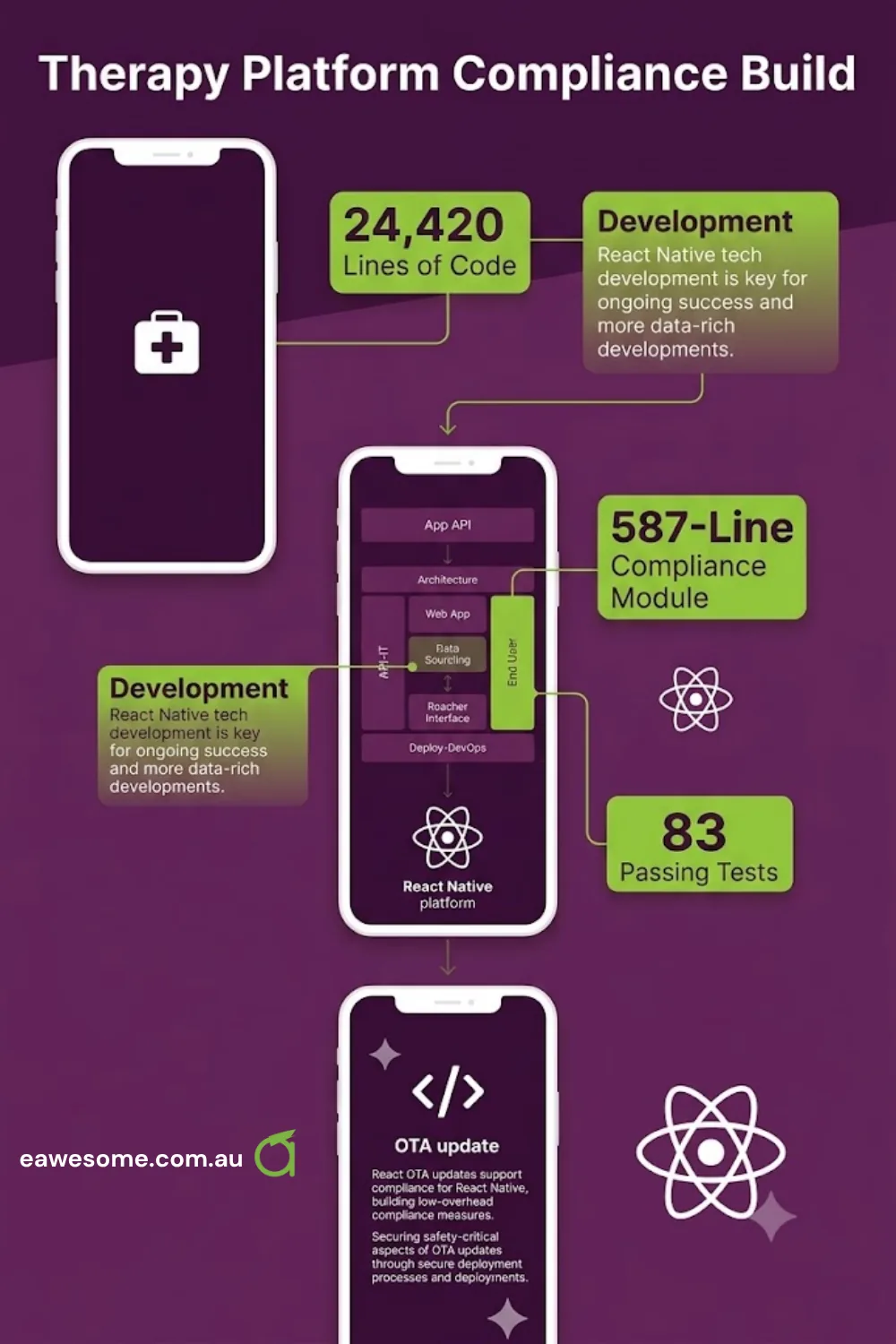
24,420 lines is not a padding number. It’s the modality-agnostic session engine, the psychology-modality overlay, the practitioner console, and the shared data-model for client outcomes.
The Australian clinical compliance work
Two days later, on 19 April 2026, we shipped the compliance layer that separates “an app for clinicians” from “an app clinicians can safely use on Australian consumers”:
| Commit | Date | Lines added |
|---|---|---|
feat: Australian clinical compliance -- crisis detection, consent gate, safety UI | 2026-04-19 | +587 |
fix(compliance): mobile app regulatory gaps -- disclaimer, screener, crisis notification | 2026-04-19 | +455 |
test: add mobile unit tests for compliance screens and crisis notification | 2026-04-19 | +258 |
The 587-line compliance push shipped three concrete pieces:
- Crisis detection — real-time triage of client input against a maintained trigger vocabulary; when the model matches, the session routes to the crisis flow rather than continuing the exercise.
- Consent gate — every clinical exercise sits behind an explicit informed-consent step that records the version of the disclaimer the client agreed to. If we later change the disclaimer, we know exactly which clients need re-consent.
- Safety UI — the visible layer of the two above. The disclaimer copy, the AHPRA-referenced practitioner-scope text, the emergency-services fallback (Lifeline 13 11 14, 000, Beyond Blue) — none of it hidden behind a settings screen.
Five days later on 24 April 2026, fix(crisis): normalise curly apostrophes before phrase matching — a 113-line follow-up. That’s the reality of shipping compliance features: the first version catches the obvious matches, then the follow-up patch fixes the “why didn’t it catch don’t when the user typed don’t?” edge case with a smart-quote in the middle.
Test coverage, not just feature coverage
The 226-line commit on 17 April notes 83 tests passing at the protocol-assignment bridge. The 258-line commit on 19 April is tests only — mobile unit tests for the compliance screens and the crisis-notification path. Two days after the compliance feature ships, the tests that would catch a regression are in.
This matters because AHPRA-relevant behaviour is where you want a red build to block deploy, not a Slack message from a clinician saying “the crisis banner didn’t appear last Tuesday.”
Why React Native + Expo for this build
We picked React Native with Expo (managed workflow) for one reason: OTA update pathway. When we need to patch the crisis-detection vocabulary or the disclaimer copy on a Wednesday afternoon, we don’t want to wait 24-72 hours for App Store review. Expo’s OTA lets us push safety-critical updates to installed clients within minutes.
The trade-off is that native-only capabilities (deep BLE integrations, some HealthKit surfaces) are more work. For a therapy platform where the safety layer changes more often than the sensor layer, that trade-off is correct.
What this proves for a health-app engagement
Awesome Apps has now shipped:
- 24,420 lines of modality-agnostic core in a single commit
- 587 lines of Australian clinical compliance in a single commit two days later
- 83 tests passing at protocol-assignment, plus a full compliance-screens test suite
If you’re an Australian health, wellness, or clinical-practice business considering a mobile build, this is the level we ship at. Not “we’ve read about compliance”; we’ve written the crisis-detection code, the consent-gate migration, and the smart-quote patch that stopped a false negative on 24 April.
The pricing this maps to
The published Awesome Apps tiers are on our pricing page — Cross-Platform from $10,000 AUD (React Native / Flutter, up to 10 screens), Native from $15,000 AUD (Swift / Kotlin, up to 15 screens). A build at the complexity of the therapy platform above sits well beyond the entry tier — closer to the enterprise range — because the compliance surface alone consumes several sprints.
The honest scoping question for your project isn’t “how many screens” — it’s “what’s the safety layer” and “does the OTA update path matter for your compliance surface.”
Frequently asked questions
What does “modality-agnostic” mean in the context of a therapy app?
Modality-agnostic means the same app can serve multiple clinical frameworks — CBT, DBT, ACT, or a psychology-specific protocol — with the framework selected per client and per session. The alternative (one app per modality) forces a multi-therapist practice to choose a single framework or run multiple apps. The architectural cost of modality-agnostic is real, but it enables the app to serve an entire clinical team from one install.
How do you handle Australian clinical compliance in a mobile app?
Three pillars: crisis detection that triages client input in real time and routes to a safety flow when triggered; a consent gate that records the specific disclaimer version each client agreed to; and safety UI that puts AHPRA-referenced practitioner-scope text and emergency-services fallback (Lifeline 13 11 14, 000) in front of the user — not buried in settings. All three shipped together in a 587-line compliance push on 19 April 2026, with unit tests two days later.
Why React Native and Expo for a clinical app instead of native?
Because the OTA (over-the-air) update path lets us push safety-critical patches — crisis-vocabulary updates, disclaimer copy fixes, edge-case bug fixes like the curly-apostrophe patch — within minutes rather than waiting on App Store review. For a therapy app where the safety layer changes more often than the sensor layer, that’s the right trade-off. Native still wins when the app is deeply BLE / HealthKit / hardware-dependent.
How many tests should a clinical mobile app carry?
More than a marketing app. We shipped the modality-agnostic core with 83 tests passing at the protocol-assignment bridge, and the compliance surface (screens + crisis notification) has its own dedicated unit-test suite that landed in the same week. Any AHPRA-relevant behaviour should have a test that fails the build — not a Slack message from a clinician after the fact.
How much does building a compliant Australian therapy app actually cost?
Awesome Apps publishes tiered pricing at /pricing: from $10,000 AUD for cross-platform (React Native / Flutter, up to 10 screens) and from $15,000 AUD for native (Swift / Kotlin, up to 15 screens). A build with a real clinical-compliance surface — crisis detection, consent gate, safety UI, tested — sits above the entry tier because the compliance work consumes multiple sprints of its own. Book a scoping call to get the specific number for your project.
Related reading
- Cost + timeline for your Australian mobile app — Mobile App Development Sydney: What $10K-$15K AUD Actually Delivers (companion pricing walkthrough)
- Ashganda on the pipeline behind this work — Adversarial verification and fail-closed gates in a production AI content pipeline — how we ship safety-critical software without silent regressions
- Book a scoping call — eawesome.com.au/contact if you’re building a healthcare, wellness, or clinical-practice app in Australia
Talk to a Sydney app developer — free.
30 minutes. We'll tell you what your app needs, how long it takes, and what it costs. Real answers, no sales pitch.
Book Free App Strategy Call →Free · 30 minutes · No obligation