Cross-Platform App Development - React Native & Flutter
Build iOS and Android apps from a single codebase. Our cross-platform development services using React Native and Flutter deliver faster time-to-market at reduced cost.
The choice between native and cross-platform development is one of the most important decisions you'll make when building a mobile app. Cross-platform frameworks like React Native and Flutter have matured significantly, offering a compelling middle ground: near-native performance with dramatically reduced development time and cost.
At Awesome Apps, we help Australian businesses navigate this decision and, when cross-platform is the right choice, deliver exceptional apps using industry-leading frameworks.
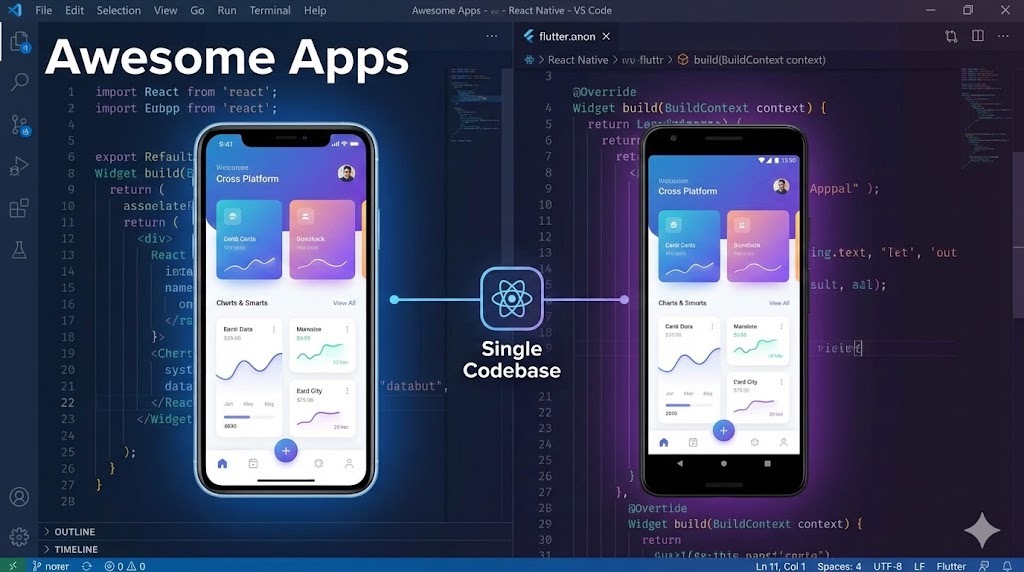
Understanding Cross-Platform Development
Cross-platform development allows you to write code once and deploy to both iOS and Android. Instead of maintaining two separate codebases with distinct teams, you work with a unified codebase that serves both platforms. Modern frameworks have evolved to deliver experiences nearly indistinguishable from native apps.
The Business Case for Cross-Platform
The numbers speak clearly: cross-platform development typically costs 30-40% less than building separate native apps. Development time reduces by similar margins. For startups validating ideas, businesses with limited budgets, or companies needing to reach both platforms quickly, this represents significant savings without major quality compromises.
React Native: Facebook's JavaScript Framework
React Native, developed by Facebook (Meta), uses JavaScript and React to build mobile applications. It's been battle-tested by major apps including Facebook, Instagram, Airbnb, and Uber Eats.
React Native Advantages
- Huge Developer Community: The largest cross-platform ecosystem with extensive libraries
- JavaScript Familiarity: Leverages the world's most popular programming language
- Hot Reloading: See changes instantly during development
- Native Modules: Access platform-specific APIs when needed
- Code Sharing: Share code between mobile and React web applications
When to Choose React Native
React Native excels for apps with standard UI patterns, content-heavy applications, e-commerce platforms for retail businesses, and social apps. It's ideal when your team already knows JavaScript or you want to share code with a React web application. Companies like Shopify have successfully built their mobile commerce platform on React Native.
Flutter: Google's UI Toolkit
Flutter, developed by Google, uses the Dart programming language and a unique rendering approach that draws every pixel directly. This gives developers complete control over the user interface.
Flutter Advantages
- Beautiful UIs: Pixel-perfect control with rich animations
- Consistent Cross-Platform: Identical appearance on iOS and Android
- Excellent Performance: Compiles to native ARM code
- Growing Ecosystem: Rapidly expanding package library
- Beyond Mobile: Single codebase for mobile, web, and desktop
When to Choose Flutter
Flutter shines for apps requiring custom, branded UI designs, animation-heavy applications like fitness apps, and MVPs that need to look polished on a budget. It's also excellent for healthcare applications requiring HIPAA compliance. Google uses Flutter for Google Pay, and companies like BMW and Alibaba have adopted it for customer-facing applications.
React Native vs Flutter: A Comparison
Both frameworks are excellent choices, but they suit different scenarios:
| Factor | React Native | Flutter |
|---|---|---|
| Language | JavaScript/TypeScript | Dart |
| Performance | Near-native | Excellent (compiled) |
| UI Flexibility | Uses native components | Custom rendering engine |
| Community | Larger, more mature | Growing rapidly |
| Best For | JS teams, web integration | Custom UI, animations |
Our Cross-Platform Development Process
1. Platform Assessment
We start by evaluating whether cross-platform is right for your project. We consider performance requirements, required native features, timeline, budget, and long-term maintenance plans. Sometimes native development is the better choice, and we'll tell you honestly.
2. Framework Selection
Based on your requirements, we recommend either React Native or Flutter. Factors include your existing technology stack, team expertise, UI complexity, and specific feature needs.
3. Shared Architecture Design
We design architecture that maximises code sharing while allowing platform-specific customisation where needed. This typically achieves 80-95% code reuse between platforms.
4. Platform-Specific Polish
While cross-platform handles most functionality, we ensure each platform feels native. This includes platform-specific navigation patterns, proper status bar handling, and appropriate use of platform conventions.
5. Dual-Platform Testing
We test extensively on both platforms, covering different device sizes, OS versions, and user scenarios. Automated testing catches regressions while manual testing ensures quality user experiences.
Cross-Platform Cost Savings
Here's how cross-platform development compares to building separate native apps:
- Simple App: Native both: $25,000-40,000 | Cross-platform: $10,000-20,000
- Medium App: Native both: $40,000-60,000 | Cross-platform: $20,000-35,000
- Complex App: Native both: $60,000-100,000 | Cross-platform: $35,000-60,000
Savings come from unified development, single QA process, and simplified maintenance. Long-term, maintaining one codebase instead of two significantly reduces ongoing costs.
When Native Still Wins
Cross-platform isn't always the answer. We recommend native development for:
- Performance-critical applications (high-end games, video processing)
- Apps requiring cutting-edge platform features on day one
- Complex hardware integrations (medical devices, industrial equipment)
- When platform-specific UX is paramount (banking apps, enterprise tools)
For projects requiring optimal platform-specific performance, consider our native iOS development or native Android development services.
Success Stories
Cross-platform frameworks power many apps you use daily:
- React Native: Facebook, Instagram, Shopify, Discord, Pinterest
- Flutter: Google Pay, BMW, Alibaba, eBay Motors, Nubank
These examples demonstrate that cross-platform development, done right, delivers production-quality applications at scale.
Get Started with Cross-Platform Development
Awesome Apps helps Sydney businesses build cross-platform applications that reach both iOS and Android users efficiently. Whether you're launching an MVP, digitising business processes, or expanding your mobile presence, we'll guide you to the right solution.
Contact us for a free consultation. We'll analyse your requirements and recommend the approach that best balances quality, timeline, and budget for your specific needs.
Talk to a Sydney app developer — free.
30 minutes. We'll tell you what your app needs, how long it takes, and what it costs. Real answers, no sales pitch.
Book Free App Strategy Call →Free · 30 minutes · No obligation
Free Mobile App Cost Guide 2026
The honest guide to app pricing in Australia — ranges, what drives cost up, and how to get the best value.